Table of Contents
Search is no longer just a list of blue links. Google’s AI Overview (AIO) has fundamentally changed how users find and consume information — and if your content isn’t structured for AI, you’re already invisible to a growing share of your audience. Whether you’re a startup, an enterprise, or a local business, understanding how AIO works is now a non-negotiable part of any best SEO services strategy.
What Is Google’s AI Overview?
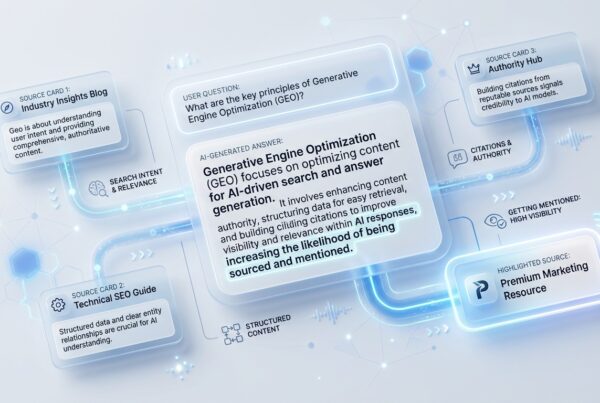
Google’s AI Overview is a generative AI-powered feature that appears at the top of search results. Instead of simply ranking ten pages, Google now synthesises information from multiple sources and presents a direct, conversational answer to the user’s query — before they ever click a link.
This is not a minor UI update. It is a structural shift in how content gets surfaced, cited, and consumed. The traditional top-10 model is giving way to an AI-first discovery model, where Google’s LLM selects content it finds most credible, most structured, and most contextually relevant.
Why Traditional SEO Alone Is No Longer Enough
For years, ranking on Page 1 meant optimising for keywords, backlinks, and page speed. That still matters — but it’s no longer sufficient. AIO doesn’t just rank your content; it reads, interprets, and selectively quotes it. If your content is a wall of unstructured paragraphs, the AI skips over it.
What Google’s AI model rewards is clarity of structure — clear questions answered directly, information organised in digestible chunks, and authoritative depth on a given topic. For any SEO agency in Chennai working with local or national clients, this means the content brief has to change. The old format of keyword-stuffed, long-form fluff will not be cited by AIO. Only content written for human comprehension — and AI parsing — will make the cut.
What “Structured for AI” Actually Means
Structuring content for AI doesn’t mean writing for a robot. It means writing with precision, hierarchy, and intent. Here’s what that looks like in practice:
Use clear H2 and H3 headings that mirror real user questions.
AIO pulls answers from content that is logically sectioned. If your subheading directly matches a search query, the likelihood of being cited increases significantly.
Lead every section with the answer, then expand.
AIO favours the “answer first” model. Don’t bury the key point at the end of a paragraph — state it upfront, then support it with context and data.
Use structured data (schema markup).
FAQ schema, HowTo schema, and Article schema all signal content structure to Google’s crawlers. This is especially critical for service pages, product pages, and resource articles.
Write in short, declarative sentences.
Long, complex sentence constructions reduce AI comprehension scores. Shorter sentences, clear transitions, and logical flow improve your chance of being selected as an AIO source.
Include demonstrable E-E-A-T signals.
Experience, Expertise, Authoritativeness, and Trustworthiness are the filter Google applies before AI sources a piece. Author credentials, original research, data-backed claims, and proper citations all matter more now than ever.
AIO and Zero-Click Search: The New Reality
One uncomfortable truth about AI Overview is that it drives zero-click behaviour. When Google answers a question directly at the top of the SERP, fewer users scroll down to organic results. Studies indicate that AIO significantly reduces click-through rates for informational queries.
However, brands that are cited in AIO gain massive visibility even without a click — brand recall, authority positioning, and trust signals that influence purchase decisions downstream. This is why partnering with a best SEO services company that understands both traditional SEO and AI-era content optimisation is essential. The goal is no longer just to rank — it’s to be the source Google trusts enough to quote.
The Window to Act Is Now
Google’s AIO rollout is still evolving, which means early movers have a real advantage. Businesses that restructure their content today — auditing existing pages, implementing schema, rewriting for AIO compatibility — will hold a compounding edge over competitors who wait.
Every content audit, every blog post, every service page is an opportunity to build an AIO-ready asset.
Conclusion
Google’s AI Overview isn’t coming — it’s already here, reshaping how content is discovered, cited, and trusted. Brands that fail to adapt will see declining organic visibility regardless of how many keywords they target.
The solution is a comprehensive content strategy built for the AI-first SERP. If you’re looking for the best SEO services to future-proof your digital presence, or working with an SEO agency in Chennai that understands the implications of AIO on your industry, the time to act is now. Partnering with a proven best SEO services company means ensuring your content doesn’t just rank — it gets cited, trusted, and discovered in the era of AI-powered search.