Table of Contents
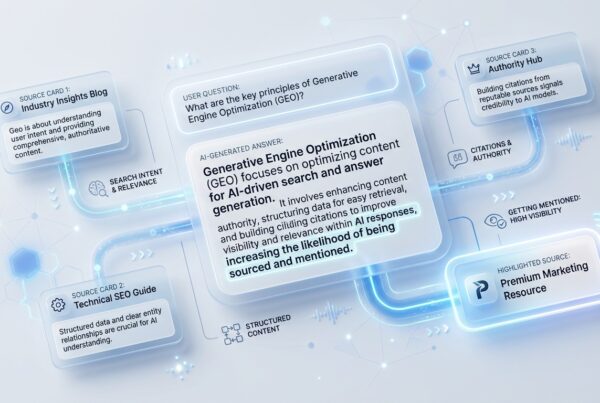
If you’ve searched anything on Google recently, you’ve probably noticed something new at the very top — a block of AI-generated answers summarising the web for you. That’s an AI Overview (formerly Search Generative Experience), and it’s now one of the most valuable pieces of real estate in search. For small businesses, getting featured there isn’t a luxury anymore — it’s a competitive necessity.
Here’s a straightforward guide on what AI Overviews are, why they matter, and exactly how your small business can start appearing in them.
What Are AI Overviews — and Why Should Small Businesses Care?
AI Overviews pull synthesised answers directly from websites and display them before any organic result. For users, it means faster answers. For businesses, it means a chance to be cited as a trusted source — without ranking #1.
Small businesses often struggle with limited ad budgets and authority gaps against larger competitors. AI Overviews level that playing field slightly: Google’s AI looks for the best answer, not just the biggest brand. If your content answers a question clearly and thoroughly, you have a genuine shot at being featured — regardless of your domain authority.
1. Write Content That Directly Answers Questions
AI Overviews are query-driven. Google’s AI is looking for concise, reliable answers to specific questions. Your content needs to be structured around questions your target audience is actually asking.
Start by identifying question-based queries in your niche. For example, a small business owner searching for the best SEO services might ask: “What does an SEO agency do for a small business?” or “How long does SEO take to show results?”
Build individual sections — or entire articles — that answer one question very clearly. Use the question as a subheading. Follow it immediately with a direct, 2–3 sentence answer. Then elaborate. This format mirrors how AI Overviews extract and summarise information.
2. Structure Your Content with Clear Headings and Lists
Google’s AI doesn’t just read your content — it parses it. Structured content with proper H2s, H3s, numbered lists, and bullet points gets processed more accurately and is more likely to be cited.
Avoid walls of text. Break down complex ideas into digestible sections. If you’re explaining a process, use a numbered list. If you’re comparing options, use a table. The cleaner your structure, the easier it is for AI to pull accurate information from your page.
3. Build Topical Authority Around Your Core Service
AI Overviews favour sources that demonstrate depth of knowledge on a subject. A single blog post won’t cut it — you need a cluster of interlinked content covering your topic from multiple angles.
For instance, if you’re positioning yourself as the go-to SEO agency in Chennai, your site should have content covering local SEO fundamentals, case studies of local businesses you’ve helped, guides on keyword research, technical SEO tips, and more. Each piece reinforces your authority on the subject, signaling to Google that your domain is a reliable source on this topic.
Partnering with or being featured by a credible best SEO services company also builds external signals that contribute to this authority.
4. Prioritise E-E-A-T: Experience, Expertise, Authority, Trust
AI Overviews pull from sources Google deems credible. E-E-A-T (Experience, Expertise, Authority, Trustworthiness) is Google’s framework for evaluating that credibility — and it plays a direct role in AI Overview selection.
Practical steps to improve E-E-A-T for small businesses:
- Add author bios with credentials to every blog post
- Include real client outcomes, case studies, or testimonials
- Earn backlinks from reputable, locally relevant sites
- Keep your NAP (Name, Address, Phone) consistent across directories
- Actively manage and respond to Google Reviews
5. Optimise for Conversational, Long-Tail Queries
AI Overviews are heavily tied to conversational and long-tail search. Short, transactional keywords like “best SEO services” are competitive — but longer variations like “what are the best SEO services for small retail businesses in Chennai” are far more actionable for AI Overview inclusion.
Layer these long-tail queries naturally into your content. Use them in subheadings, FAQ sections, and meta descriptions. This doesn’t mean keyword stuffing — it means speaking the same language your customer uses when they search.
6. Add an FAQ Section to Every Key Page
FAQ sections are among the most commonly cited content types in AI Overviews. Add a structured FAQ block at the bottom of every service page and blog post. Use schema markup (FAQPage) to make the content machine-readable, helping Google’s AI extract and attribute your answers accurately.
Final Thought
Ranking in AI Overviews is less about gaming algorithms and more about earning trust through quality content. Small businesses that invest in structured, authoritative, question-focused content — backed by the right technical foundations — are already ahead of the curve.
If you’re unsure where to start, working with the best SEO services team that understands both traditional search and AI-driven discovery is the smartest first step. The search landscape is changing fast — your content strategy should too.