Table of Contents
Search has changed more in the last eighteen months than it did in the previous decade. AI-generated answers are now the first thing millions of users see — before any blue link, before any ad, before any organic result. If your best SEO services strategy is still built entirely around ranking on page one, you are optimising for a search experience that is rapidly becoming secondary. Every SEO agency in Chennai and across the country needs to reckon with this shift. GEO — Generative Engine Optimization — is the future. It is a present-tense requirement, and any best SEO services company that isn’t building it into client strategies right now is already falling behind.
What GEO Actually Is — and Why It Is Not Optional
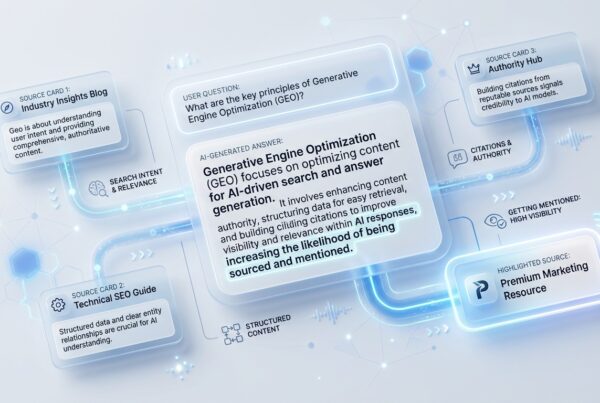
Generative Engine Optimization is the practice of structuring your content, authority signals, and entity clarity so that AI systems — ChatGPT, Google’s AI Overviews, Bing Copilot, Perplexity, Gemini — pull from your website when generating answers.
When a user types a question into an AI-powered search interface, the system doesn’t scroll through links. It synthesises an answer from sources it considers authoritative, well-structured, and relevant. If your website isn’t one of those sources, you don’t exist in that interaction — regardless of your domain authority or keyword rankings.
This is the reality that makes GEO non-negotiable. Organic click-through rates from traditional search results are declining as AI Overviews absorb more of the answer space. Businesses that adapt now build citation equity in AI systems while competitors are still focused exclusively on rank tracking.
How GEO Differs from Traditional SEO
Traditional SEO is primarily about signals — backlinks, keyword density, page speed, technical health — that tell search engine algorithms your page deserves to rank. GEO is about substance. AI systems evaluate whether your content is genuinely useful, clearly structured, and trustworthy enough to cite in front of a user expecting an accurate answer.
The differences in practice are significant:
Keyword matching vs. intent resolution. SEO targets queries. GEO targets topics. AI systems aren’t matching keywords — they are resolving user intent, which means your content needs to comprehensively cover a subject, not just mention a phrase.
Ranking vs. citation. In SEO, success is a position on a results page. In GEO, success is being the source an AI references when answering a relevant question. These require different content architectures.
Link authority vs. entity authority. Backlinks remain important in SEO. GEO additionally rewards entity clarity — how clearly your brand, location, category, and expertise are established across your site and the wider web.
What GEO Requires From Your SEO Strategy
The best SEO services in 2026 don’t abandon traditional optimisation — they extend it. Here is what needs to be added:
Structured, answer-first content. Every service page, blog post, and landing page should contain direct, concise answers to the questions your audience is actually asking. Paragraphs of 40–60 words that answer a specific question are far more likely to be cited than dense blocks of promotional copy.
Schema markup at scale. FAQPage, HowTo, Service, LocalBusiness, and Article schemas give AI systems machine-readable signals about what your content covers and how credible your source is. Any SEO agency in Chennai delivering GEO-ready work should be implementing JSON-LD schema as standard.
E-E-A-T reinforcement. Experience, Expertise, Authoritativeness, and Trustworthiness aren’t just Google Quality Rater guidelines anymore — they are the criteria AI systems use to determine which sources deserve to be cited. Author credentials, case studies, client results, and third-party mentions all feed into this.
Consistent entity signals. Your business name, category, service areas, and contact details need to be stated clearly and consistently across your website, Google Business Profile, industry directories, and any external mentions. Inconsistency creates ambiguity for AI systems trying to verify who you are.
Rendering and crawlability. AI systems can’t cite what they can’t read. If your website relies heavily on JavaScript rendering without server-side fallbacks, large portions of your content may be invisible to AI crawlers entirely.
The Businesses That Move Now Will Own Tomorrow’s Search
GEO is still early enough that meaningful competitive advantages are available to businesses willing to act. The window won’t stay open indefinitely. As more brands recognise the shift and invest in GEO-aligned content and technical infrastructure, the citation landscape will become more competitive — exactly as keyword rankings did a decade ago.
Every best SEO services company worth its retainer is having this conversation with clients today — not waiting for traffic to drop before recommending a strategy shift. If your current best SEO services partner hasn’t raised GEO yet, it is worth asking why. And if you are evaluating a new SEO agency in Chennai for 2026, make GEO readiness a non-negotiable part of the brief.
The businesses ranking in AI answers six months from now started optimising for it six months ago.